Why Operational Simplicity Matters in a Service Franchise Business
The modern entrepreneurial landscape is full of choices, yet many aspiring business owners find themselves trapped in a paradox. They crave the independence of business ownership but are often intimidated by the sheer complexity of managing inventory, navigating massive supply chain disruptions, and maintaining an expensive brick-and-mortar commercial storefront. In the world of franchising, complexity is often the silent killer of profitability and growth. When systems are bloated, heavy with administrative friction, and weighed down by high fixed overhead, the business owner spends more time fighting fires than building customer relationships.
This reality explains why operational simplicity has become the gold standard for modern business investments. For individuals evaluating options, looking closely at how a brand structures its daily workflows is a critical step. A service franchise business that prioritizes straightforward, repeatable, and lean workflows provides a massive advantage. Operational clarity allows owners to launch faster, scale more efficiently, and protect their margins against fluctuating economic headwinds.
By analyzing proven business frameworks like Fibrenew, an industry leader in leather, plastic, and vinyl restoration, we can see exactly why keeping things simple is a powerful strategy for sustainable long-term success.
The True Cost of Operational Complexity
To understand why simple systems work so well, it is helpful to look at what happens when a business model is overly complex. Traditional retail or food-and-beverage franchises come with an intense amount of operational baggage. Franchisees must lease high-traffic retail spaces, manage build-outs that face supply chain delays, hire large shift-based teams, and manage rotating inventory that can spoil or become obsolete.
When a system has so many moving parts, a franchise owner becomes tied to the physical location. Their energy is drained by daily management tasks rather than business development.
In contrast, investing in a service franchise business built on operational simplicity removes these heavy structural barriers. When you eliminate the need for a physical retail footprint and strip out unnecessary layers of management, the business becomes incredibly agile.
Owners can focus entirely on delivering high-quality service, securing commercial contracts, and maintaining healthy profit margins. Simplicity is not about cutting corners or offering less value; it is about engineering a system where every action directly contributes to revenue generation and customer satisfaction.
Decoding Streamlined Franchise Systems
The core of any successful simple business model is a foundation of streamlined franchise systems. A truly streamlined system takes complex, technical procedures and breaks them down into clear, repeatable actions that almost anyone can master with the right training. This approach democratizes business ownership, allowing professionals from corporate backgrounds, trades, or management to transition seamlessly into a completely new industry.
Consider the operational framework developed by Fibrenew. Over nearly four decades of refining their business model, they have perfected the art of vinyl, plastic, and leather restoration. The physical repair process relies on highly specialized techniques and proprietary products, but the business management side is structured for maximum clarity.
Franchisees receive comprehensive initial training followed by structured ongoing field support, meaning they do not need prior restoration experience to succeed. The corporate team handles product research, technological updates, and high-level marketing strategies, allowing local owners to focus on execution within their protected territories.
Deploying streamlined franchise systems protects a business owner’s most valuable asset: time. When administrative processes, ordering workflows, and customer service protocols are standardized and integrated into user-friendly platforms, the business runs smoothly. Franchisees avoid the analysis paralysis that often stalls independent start-ups, relying instead on a clear roadmap that has been tested and proven across hundreds of global markets.
The Strategic Power of Mobile Business Operations
One of the most effective ways to simplify a business model is to take it on the road. Integrating mobile business operations into a franchise model completely transforms the cost structure and flexibility of the venture. By operating from a branded vehicle, a business owner eliminates rent, property taxes, structural utility bills, and the costly maintenance associated with physical retail spaces.
A mobile format turns a business into a highly visible, rolling billboard. Every trip to a residential home, automotive dealership, marina, or medical clinic serves as local marketing. This setup creates an incredibly responsive service loop. Instead of waiting for customers to walk through a door, mobile business operations meet them exactly where they are, providing rapid, on-site service that traditional businesses simply cannot match.
Furthermore, mobile setups offer unparalleled personal freedom. Because the business is not tied to retail operating hours, owners can adjust their schedules around personal and family commitments. This level of flexibility is a major reason why modern entrepreneurs gravitate toward mobile service concepts. It provides a rare combination of strong earning potential and genuine control over one’s daily life.
Low Fixed Overhead as an Economic Shield
Every dollar spent on fixed overhead is a dollar that cannot be reinvested into growing the business or saved as profit. In unpredictable economic environments, high fixed overhead is a dangerous vulnerability. If consumer spending slows down, a business with massive monthly rent obligations and a large payroll can quickly find itself under financial strain.
Operating a low overhead business designed around a lean framework provides a much safer financial buffer. When fixed expenses are kept to a minimum, the break-even point drops significantly. This lean structure allows the enterprise to remain profitable even during broader market slowdowns.
Because a mobile restoration business offers an alternative to the high cost of replacement, it naturally transforms into a recession resistant franchise. When individuals and corporate clients choose to repair worn assets rather than buying new ones, a lean service model is perfectly positioned to capture that demand.
Navigating Multiple Diverse Revenue Streams
A common misconception about simple businesses is that they have limited growth potential. In reality, operational simplicity makes it much easier to diversify your client base and access multiple revenue streams simultaneously. When a business model is not weighed down by complex production limits or location-based constraints, scaling a service franchise becomes a realistic and highly profitable long-term goal.
For example, a restoration professional using simple, mobile systems can serve a wide variety of industries on any given day:
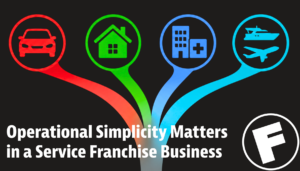
- Automotive: Repairing cracked dashboards, torn leather seats, and faded vinyl trim for local dealerships, rental car fleets, and private owners.
- Residential: Restoring luxury leather couches, direct-sun-faded recliners, and damaged plastic window casings right in the homeowner’s living room.
- Commercial and Medical: Renewing worn examination tables in doctor’s offices, vinyl seating in restaurant booths, and office chairs in corporate spaces where pristine presentation is mandatory.
- Marine and Aviation: Fixing cracked vinyl boat cushions exposed to harsh weather or restoring interior elements of private aircraft to meet strict aesthetic standards.
Because the core restoration processes remain consistent across all of these sectors, the business owner does not need to learn multiple entirely different trades. They use the same core skills and proprietary products to unlock diverse, non-cyclical revenue streams, making the business exceptionally resilient.
Built-In AI Resistance and Long-Term Stability
As artificial intelligence and automation continue to reshape the economy, many traditional jobs and business models face disruption. When choosing a franchise, it is smart to consider how safe the concept is from technological obsolescence.
This is where specialized, hands-on service franchises excel. The physical precision, artistic touch, and custom color matching required to restore a torn leather seat or a damaged piece of plastic cannot be replaced by software or a digital algorithm.
It requires human skill, a keen eye for detail, and physical dexterity. By investing in a service model that pairs advanced proprietary chemical products with skilled manual execution, franchise owners secure a business that is uniquely protected against AI displacement.
Evaluating the Support Ecosystem
Operational simplicity is rarely achieved entirely on one’s own. It requires a dedicated corporate team working continuously behind the scenes to keep the model clean, efficient, and competitive. When researching franchise opportunities, it is essential to look closely at the depth and quality of the support network provided by the franchisor.
A great franchisor functions as an active business partner. They manage product innovation, manufacture high-quality materials, negotiate national vendor contracts, and provide ongoing technical and marketing training. This corporate backing ensures that while you are working for yourself, you are never left to figure things out by yourself.
From customized software that simplifies scheduling and invoicing to expert technical support lines available when you face a challenging repair in the field, this backing transforms a solo operator into part of a powerful global brand.
Making the Right Choice for Your Future
Ultimately, choosing a franchise business is about defining the kind of life you want to lead. If your goal is to spend your days managing large staff turn-overs, paying high monthly lease costs, and dealing with complex inventory issues, a traditional retail model might work for you. However, if you want a career focused on high margins, direct control over your daily schedule, and an efficient, low-overhead operation, simplicity is the clear path forward.
Look for models that have stood the test of time, maintained consistent growth across decades of changing market conditions, and built a genuine, family-like culture of mutual support among their owners. When a franchise system successfully strips away unnecessary operational friction, it empowers you to focus on what matters most: delivering exceptional service, building a strong local reputation, and creating financial freedom for your family.
Are you ready to break free from the corporate grind and build a stable, rewarding future on your own terms? Explore how a mobile service model backed by decades of proven success can help you achieve your goals. Visit the Fibrenew Franchising Insights Hub today to download your comprehensive information report, learn about available territories, and find out how our community supports entrepreneurs every step of the way.
Frequently Asked Questions
Q: Do I need prior technical or restoration experience to open this type of service franchise business?
A: No, prior experience in restoration is not required. A well-structured service franchise business provides comprehensive initial training that covers all technical skills, chemical processes, and color-matching techniques from the ground up. Ongoing field support ensures you can confidently handle complex jobs as you scale your mobile operations.
Q: How do mobile business operations compare to a traditional storefront franchise?
A: Operating with mobile business operations eliminates the heavy overhead of a brick-and-mortar storefront, including high commercial rent, property maintenance, and utility bills. It allows you to run a highly agile, low overhead business out of a customized vehicle, taking your services directly to commercial and residential clients while enjoying total control over your daily schedule.
Q: What makes a streamlined franchise system more resilient during economic downturns?
A: Streamlined franchise systems keep fixed expenses low, lowering your monthly break-even point. Furthermore, because these models often provide high-quality repairs as an alternative to the high cost of replacement, demand stays strong during economic challenges, transforming the business into a truly recession resistant franchise.
Q: Can a mobile service franchise easily expand and scale over time?
A: Yes, scaling a service franchise is highly manageable. Because the model is built on low overhead and operational simplicity, you can scale your business by adding more branded vehicles and hiring technicians to cover expanded service areas, all without the massive capital required to build out new retail locations.