
Can Furniture Restoration Help Reduce Scope 3 Emissions
The global corporate community has reached a pivotal turning point where environmental responsibility is no longer a peripheral concern, but a core driver of business value. As organizations strive to align with the Paris Agreement and various international climate accords, the complexity of carbon accounting has come into sharp focus. While most companies have made significant strides in managing their direct energy use, the true challenge lies in the “invisible” part of their environmental impact: the value chain. This is where the concept of scope 3 emissions furniture procurement becomes a critical factor for any business maintaining a physical presence.
For the modern sustainability officer or facility manager, the question is no longer just about whether to go green, but how to do so effectively and transparently. Scope 3 emissions represent the indirect greenhouse gas (GHG) emissions that occur throughout a company’s entire value chain, including both upstream and downstream activities. For many sectors, specifically hospitality, healthcare, and corporate offices, the acquisition and disposal of physical assets like seating and surfaces constitute a massive portion of these indirect emissions. By integrating furniture restoration into their broader corporate sustainability strategies, businesses can unlock a powerful lever for meaningful change.
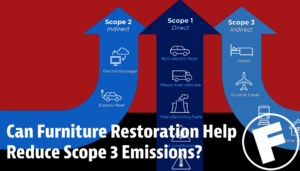
The Hidden Weight of Scope 3 Emissions in Furniture
To truly appreciate the role of restoration, one must first look at the traditional linear model of “take, make, waste.” When a company purchases new office chairs, lobby sofas, or medical exam tables, they are not just buying a piece of equipment; they are inheriting the total carbon cost of that item’s creation. This includes the extraction of ores for metal frames, the harvesting of timber, the chemical intensive production of synthetic fabrics, and the petroleum based manufacturing of foam and plastics.
This embodied carbon is the primary driver of scope 3 emissions furniture data. Every step of the manufacturing process requires massive amounts of energy, much of which is still derived from fossil fuels. Furthermore, the global nature of modern supply chains means that a single chair might travel thousands of miles by sea and road before it reaches its final destination. This logistics heavy model adds a significant layer to the carbon footprint of every new purchase.
When these items show signs of wear, the traditional response has been to discard them and buy new. This “linear” approach creates a recurring cycle of high impact emissions. However, by shifting toward circular economy furniture practices, businesses can stop this cycle. Restoration allows an organization to keep the “carbon investment” they have already made in their existing assets, essentially freezing the need for new manufacturing and transportation emissions.
Driving Carbon Footprint Reduction Through Asset Longevity
The most effective way to achieve carbon footprint reduction is to stop creating waste in the first place. Every time a professional technician performs an upholstered furniture repair, they are effectively preventing the carbon spike associated with a new purchase. Restoration is not merely a cosmetic fix; it is a strategic environmental intervention.
Consider the materials involved in commercial seating. Leather, vinyl, and high performance plastics are durable, but they are also energy intensive to produce. When a leather sofa in a corporate lobby begins to crack or fade, the structural integrity of the frame is usually still perfectly intact. Discarding that frame because of surface wear is an environmental tragedy. Professional restoration services can refinish the leather, repair tears in vinyl, and even re-dye surfaces to match updated branding, all while using a fraction of the energy and raw materials required for a new item.
This focus on longevity is the cornerstone of sustainable operations. By maintaining what we already have, we reduce the demand for virgin materials. This, in turn, lessens the pressure on global ecosystems and reduces the overall GHG output of the industrial sector. In a world where resources are finite, the ability to extend the life of an asset is a superpower for any sustainability minded organization.
Circular Economy Furniture: A Practical Corporate Strategy
The concept of a circular economy is often discussed in abstract terms, but furniture restoration provides a tangible, actionable example of this philosophy in practice. In a circular model, products and materials are kept in use for as long as possible, extracting their maximum value before they are eventually recycled or repurposed.
Restoration is the purest form of circularity because it maintains the product in its original form at its highest utility. Unlike recycling, which often involves “downcycling” materials into lower quality products through energy intensive processes, restoration preserves the quality and craftsmanship of the original piece. For businesses, adopting circular economy furniture strategies means moving away from the “disposable” mindset. It means viewing a fleet of office chairs or a suite of hotel room furniture as a long term resource that requires stewardship rather than replacement.
This shift in perspective is essential for meeting modern corporate sustainability strategies. When a business chooses to restore rather than replace, they are actively participating in a system that values resource efficiency over consumption. This not only benefits the planet but also strengthens the company’s brand as a leader in authentic environmental action.
Enhancing ESG Reporting Furniture Data Through Restoration
Environmental, Social, and Governance (ESG) reporting has become the standard by which investors and stakeholders measure a company’s impact. Within these reports, the ability to demonstrate clear, data driven progress in carbon reduction is paramount. However, reporting on Scope 3 can be notoriously difficult because it relies on data from external suppliers and manufacturers.
This is where the value of restoration becomes even clearer for ESG reporting furniture metrics. Because restoration is a controlled, internal decision, it provides a direct and measurable way to report on avoided emissions. When an organization partners with a restoration specialist, they can quantify their impact in terms of:
- Landfill Diversion: Tracking the total weight of furniture prevented from entering the waste stream.
- Avoided Procurement: Calculating the carbon savings by not purchasing new units.
- Asset Life Extension: Demonstrating a measurable increase in the usable life of corporate assets.
These metrics are “high quality” data points for ESG reports. They show that the company is not just relying on vague “green” claims from suppliers but is taking direct action within its own operations to minimize its footprint. This level of transparency is exactly what modern investors and regulatory bodies are looking for.
Landfill Diversion and the Crisis of Bulky Waste
One of the most pressing environmental issues facing local municipalities is the management of bulky waste. Furniture is a major contributor to landfill overflow, often because it is difficult to break down and recycle. Large sofas, desks, and chairs take up massive amounts of space and, as they decompose, they can release harmful chemicals and greenhouse gases like methane into the atmosphere.
A commitment to landfill diversion is a critical component of any comprehensive environmental policy. By prioritizing upholstered furniture repair, businesses can significantly reduce their contribution to this waste stream. Every item that is restored is an item that does not end up in a hole in the ground.
For large scale facilities like hospitals or universities, the volume of furniture managed is staggering. A single renovation project can result in hundreds of pieces of furniture being sent to the landfill. By integrating restoration into the renovation process, these institutions can save thousands of pounds of waste while maintaining a fresh, updated look. This proactive approach to waste management is a key indicator of a mature and effective sustainability program.
Sustainable Operations: The Economic and Environmental Nexus
While the environmental arguments for restoration are undeniable, the economic benefits are equally compelling. In the past, sustainability was often viewed as a “cost center,” an expensive but necessary addition to the budget. However, in the context of furniture management, sustainable operations are actually a “profit center” or, at the very least, a significant cost saving measure.
The cost of professionally restoring a high quality piece of leather or vinyl furniture is typically a small fraction of the cost of a comparable new replacement. When you add in the avoided costs of shipping, assembly, and the disposal fees for the old furniture, the financial case for restoration becomes overwhelming.
Furthermore, as carbon taxes and “polluter pays” regulations become more common across the globe, the financial risk of high carbon procurement is increasing. Businesses that have already optimized their processes for carbon footprint reduction will be much better positioned to navigate a regulated economy. Restoration is a low risk, high reward strategy that protects both the bottom line and the environment.
Implementing Restoration in Corporate Sustainability Strategies
To effectively leverage restoration as a tool for Scope 3 reduction, organizations should consider the following steps as part of their corporate sustainability strategies:
- Life Cycle Assessment: Evaluate the current state of all furniture assets. Identify pieces that are structurally sound but aesthetically worn.
- Restoration First Policy: Establish a protocol where repair and restoration are always considered before a replacement purchase is authorized.
- Strategic Partnerships: Work with experienced restoration professionals who specialize in commercial grade materials like leather, vinyl, and high density plastics.
- Employee Engagement: Educate staff on the importance of asset stewardship. When employees understand the environmental value of their office environment, they are more likely to treat it with care.
- Data Integration: Ensure that every restoration project is logged and tracked for the purpose of future ESG reporting.
By making restoration a standard part of the operational playbook, businesses can create a culture of sustainability that permeates every level of the organization.
The Future of the Workplace: Quality Over Quantity
As we look toward the future, the design and management of corporate spaces are evolving. There is a growing trend toward “high quality, low impact” environments. This means investing in furniture that is built to last and, more importantly, built to be repaired.
The era of “fast furniture” is coming to an end. Businesses are realizing that cheap, disposable items are an environmental and financial liability. Instead, the focus is shifting toward timeless, durable pieces that can be refreshed and restored over decades. This is the heart of the circular economy furniture movement.
In this new paradigm, a scuff on a leather chair is not a reason to throw it away; it is an opportunity for a professional touch up that keeps the item in service. A change in office color scheme is not a reason to replace the seating; it is an opportunity to re-dye the existing vinyl to match the new aesthetic. This level of flexibility and resilience is what will define the most successful and sustainable businesses of the coming years.
Take Action With Sustainable Asset Management and Furniture Restoration
Reducing the impact of scope 3 emissions furniture is challenging, but achievable through smarter asset management. By prioritizing upholstered furniture repair, landfill diversion, and circular economy furniture practices, organizations can significantly reduce their environmental footprint while improving long-term value.
True carbon footprint reduction does not rely solely on new purchases. It comes from extending the life of what already exists through restoration and repair. This shift toward restoration over replacement supports stronger sustainable operations, reduces waste, and reinforces effective corporate sustainability strategies and ESG reporting furniture goals.
By choosing specialized repair services for your leather, vinyl, and upholstery, you are taking a direct stand for the planet. Each restored piece helps divert materials from landfills, reduce emissions, and support a more responsible approach to resource use.
Professional restoration is a practical step toward sustainable asset management helping businesses maintain quality interiors while actively contributing to a circular economy and a lower-impact future.
Discover how expert restoration solutions can support your sustainability goals and transform your existing furniture into long-lasting assets. Together, we can extend furniture life cycles, reduce environmental impact, and build a more sustainable future through restoration over replacement.
Frequently Asked Questions
Q: What is the difference between Scope 1, 2, and 3 emissions?
A: Scope 1 refers to direct emissions from owned or controlled sources. Scope 2 covers indirect emissions from the generation of purchased electricity, steam, heating, and cooling. Scope 3 includes all other indirect emissions that occur in a company’s value chain, such as the production and transportation of office furniture.
Q: How does furniture restoration contribute to a circular economy?
A: Restoration keeps products and materials in use at their highest value for as long as possible. By repairing rather than replacing, you avoid the energy intensive processes of manufacturing and recycling, which is the core goal of circular economy furniture models.
Q: Is it possible to track the carbon savings from restoration for ESG reports?
A: Yes. Businesses can calculate the avoided carbon by comparing the footprint of a new purchase (including manufacturing and shipping) against the minimal footprint of a local restoration service. This data is invaluable for ESG reporting furniture sections.
Q: What types of commercial furniture are best suited for restoration?
A: Any furniture with high quality internal frames is a candidate. This includes leather lobby seating, vinyl medical tables, office chairs, and hospitality booths. As long as the structure is sound, the surface materials can almost always be restored.
Q: How does restoration help with landfill diversion goals?
A: Commercial furniture is often bulky and difficult to process as waste. By restoring items on site, you prevent them from ever entering the waste stream, which directly supports your company’s landfill diversion and waste reduction targets.
Q: Are the chemicals used in restoration environmentally friendly?
A: Modern professional restoration often utilizes low VOC (Volatile Organic Compound) and water based products that are much safer for the environment and indoor air quality than the industrial chemicals used in mass manufacturing. This further supports your commitment to sustainable operations.