
Private Jet Maintenance: When to Repair Seats, Panels, and Armrests
The High Stakes of Cabin Aesthetics
In private aviation, the condition of an aircraft’s interior is a clear signal of overall maintenance quality. For corporate flight departments and luxury charter operators, the cabin is where passengers spend their time and where first impressions are made.
Yet, private jet maintenance often prioritizes engines and avionics, leaving the interior overlooked. This creates a gap that directly affects passenger experience and long-term value.
Worn leather seats, scuffed panels, and cracked armrests are not just cosmetic flaws; they are visible indicators of how well an aircraft is maintained. Left unaddressed, these issues can lower perceived quality, reduce resale value, and increase future repair costs.
This is where specialized solutions like marine vinyl and plastic restoration and repair service come into play. Originally developed for high-wear, high-exposure environments, these techniques are highly effective in aviation interiors as well. Through marine vinyl and plastic restoration, operators can restore durability, appearance, and color consistency across frequently used cabin surfaces.
By treating interior upkeep as a core part of maintenance not an afterthought; operators can protect asset value, enhance passenger satisfaction, and maintain a consistent standard of luxury.
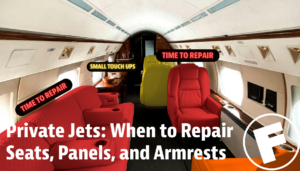
At a Glance: The Repair vs. Replace Decision Matrix
When an interior component shows signs of age, maintenance managers face a fork in the road. Use this table to determine the most efficient path.
| Feature | Choose Restoration/Repair | Choose Full Replacement |
| Leather Condition | Scuffs, fading, minor tears, ink stains | Dry rot, “cardboarding,” structural foam failure |
| Plastic/Vinyl | Hairline cracks, surface scratches, yellowing | Shattered pieces, missing structural chunks |
| Timeframe | 2–24 hours (On-site/Mobile) | Weeks to Months (Shipping & Lead times) |
| FAA Status | Compliant with certified top-coats | Requires new burn-test certification |
| Cost | 10% – 25% of replacement cost | 100% + Installation & Shipping |
Restoring Aircraft Leather: Beyond the Surface
Why Aviation Leather is Unique
Aviation leather isn’t like the leather in a luxury car. It is treated with specific flame retardants and must remain breathable to handle rapid pressurization cycles.
The Restoration Process
Professional aviation leather restoration involves a multi-step chemical process:
- Deep De-greasing: Removing oils that have penetrated the grain.
- Structural Stabilization: Bonding fibers in torn or thinning areas.
- OEM Color Matching: Using spectrophotometers to match the exact “Cloud Gray” or “Champagne” of the original manufacturer.
- Protective Top-Coating: Applying a finish that meets durability requirements without compromising the “hand” (feel) of the leather.
Hard Surface Repair: Panels, Trays, and Shrouds
The “hard” parts of a jet; window reveals, fold-down tables, and overhead bins are often made of specialized plastics and composites. These are prone to stress cracking due to the constant vibration and thermal expansion of the fuselage.
Instead of waiting 12 weeks for a backordered OEM window shroud, Fibrenew technicians can perform plastic welding and grain matching. By reinforcing the back of the panel and re-texturing the front, the repair becomes invisible and, in many cases, stronger than the original part.
Compliance and Safety: The FAA Standard
Safety is the bedrock of private jet maintenance. Any material added to an aircraft interior including dyes, fillers, and finishes must not compromise the fire-blocking characteristics of the seat.
Expert Note: Fibrenew’s restoration processes are designed to be FAA-compliant. We use high-grade, water-based products that have been tested to ensure they do not alter the flammability ratings of the underlying materials. This allows owners to maintain their Certificate of Airworthiness without the headache of re-testing every seat.
The Economic Impact: Reducing AOG Time
“Aircraft on Ground” (AOG) is a phrase every owner hates. Every day a jet sits in a hangar is a day it isn’t generating revenue or providing utility.
- Replacement often requires removing seats and shipping them to a specialized upholstery shop.
- Restoration is mobile. A Fibrenew technician can work inside the cabin while your mechanics are performing an engine inspection or avionics upgrade.
By nesting interior repairs within existing maintenance windows, you effectively reduce your interior maintenance cost to near zero in terms of lost flight time.
Sustainability: The “Green” Hangar Initiative
The aviation industry is under increasing pressure to reduce its carbon footprint. While much of this focus is on Sustainable Aviation Fuel (SAF), the “circular economy” of the cabin is equally important.
By repairing a 100-lb leather captain’s chair instead of discarding it, you prevent leather, foam, and plastic from entering a landfill. Fibrenew helps the aviation industry keep thousands of tons of materials in service annually, aligning your flight department with global ESG (Environmental, Social, and Governance) goals.
Maximizing Asset Value
The decision to repair vs. replace is a strategic one. For minor to moderate wear, aviation interior restoration offers a faster, more cost-effective, and more sustainable path than replacement; all while maintaining the strict safety standards required by the FAA. Click Here to Find a Fibrenew Aviation Expert Near You!
Frequently Asked Questions
Q: Will restoration affect the fire-blocking of my seats?
A: No. When performed by specialists using aviation-grade products, the restoration does not compromise the flame-retardant properties of the materials. We use products designed to meet FAA standards.
Q: Can you fix “ink tracks” from pens on leather seats?
A: Yes. Ink is one of the most common issues in charter aircraft. We use specialized cleaners to lift the ink and, if necessary, re-pigment the area to ensure the stain is completely erased without damaging the leather grain.
Q: How much can I save by repairing instead of replacing?
A: On average, restoration costs between 15% and 30% of the cost of a full interior replacement. For a mid-size jet, this can represent savings of $20,000 to $50,000.
Q: Can Fibrenew work on-site at the airport?
A: Yes. Our service is fully mobile. We can perform repairs in your hangar or on the ramp, provided the environment is controlled and safe for work.
Q: What is the lifespan of a repaired seat?
A: With proper care and conditioning, a restored leather seat can last as long as the original often 5 to 10 years depending on flight frequency and passenger load.