
The Ultimate Guide to Boat Interior Restoration: Revive Your Vessel’s Luxury and Value
What is boat interior restoration? Boat interior restoration is the specialized process of repairing and renewing damaged marine surfaces, including vinyl seating, leather upholstery, plastic trim, and dashboards. Unlike a total interior replacement, restoration focuses on fixing specific damage such as tears, UV fading, cracks, and mold stains using advanced chemical bonding and precision color-matching techniques. This highly targeted approach is remarkably cost-effective, environmentally friendly, and essential for maintaining a boat’s resale value, aesthetics, and structural integrity.
Owning a boat is more than just a hobby; it is a lifestyle defined by sun, salt, and the open water. However, the very elements that make boating so incredibly enjoyable are the primary enemies of your vessel’s aesthetic and structural lifespan. Over time, the pristine white vinyl turns chalky, the supple leather captain’s chairs become stiff and brittle, and the once-vibrant plastic dashboard begins to crack under the relentless, daily assault of ultraviolet (UV) rays.
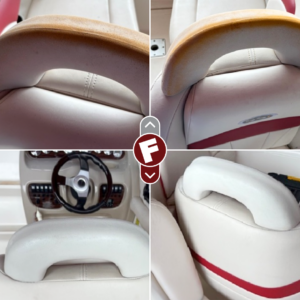
When the wear and tear become too much to ignore, boat owners are faced with a critical and often expensive decision: should you spend a small fortune on a total interior replacement, or is boat interior restoration the smarter, more efficient path?
We will explore the science of marine upholstery degradation, the massive financial benefits of repairing over replacing, and exactly how professional mobile services like those pioneered by Fibrenew can make your boat look showroom-new without the dreaded “new boat” price tag.
Why Boat Interior Restoration is a Vital Financial Investment
A boat’s interior is essentially its “living room” on the water. When that space is compromised by split seams, ripped sunpads, faded patches, or cracking plastic trim, the entire boating experience suffers. However, timely boat interior restoration is significantly more than just a cosmetic upgrade to make your vessel look pretty; it is a highly strategic financial move.
Preserving and Maximizing Resale Value
In the competitive marine market, first impressions dictate the final sale price. When a potential buyer steps onto your deck, they will immediately look at the condition of the upholstery to gauge how well the rest of the boat has been maintained. Cracked vinyl, heavily sun-damaged trim, and stained carpets instantly suggest overall neglect. Buyers will assume that if you didn’t care for the seats, you likely didn’t care for the engine, either. This leads to severe low-ball offers. A professionally restored interior can add thousands of dollars back to your asking price, ensuring your investment remains liquid and highly desirable.
Preventing Catastrophic Structural Failure
Marine upholstery acts as a vital, waterproof “skin” that protects the high-density foam cores and the wooden or composite frames hidden beneath. When a small crack or puncture appears, it is not just an annoying eyesore it is an open gateway for moisture. Water intrusion quickly leads to “foam rot.” Once the foam degrades, it loses its ability to support weight, transferring that stress to the underlying frame. Professional boat interior restoration chemically seals these breaches before water can penetrate, protecting the core of your marine furniture from expensive, deep-seated rot that would otherwise mandate a complete rebuild.
Enhancing Comfort and Safety
Hard, cracked, and sun-baked vinyl is incredibly uncomfortable to sit on, especially in a bathing suit. Furthermore, exposed foam can easily snag expensive fishing gear, life jackets, or clothing. In extreme cases, compromised helm seating can become a safety hazard in rough waters if the structural support fails. Restoration brings back the soft, supple feel of the original material, ensuring a safe and comfortable ride for your family and guests.
The Primary Enemies: What Destroys Marine Upholstery?
To restore a boat’s interior effectively, you must first understand exactly what caused the damage. Marine environments are uniquely hostile, subjecting man-made materials to a daily barrage of chemical and environmental attacks.
Ultraviolet (UV) Radiation and Off-Gassing
The sun is the undisputed number one destroyer of marine interiors. Marine vinyl and leather rely on chemical additives called “plasticizers” to remain soft, pliable, and flexible. As the sun beats down on your boat, intense UV rays literally bake these plasticizers out of the material in a process called off-gassing. As the chemicals evaporate, the vinyl becomes stiff, dry, and incredibly brittle. This leads to “alligatoring,” which is a severe cracking pattern that looks like reptile skin. UV rays also bleach the color pigments, turning vibrant reds and deep blues into dull, chalky, washed-out shadows of their former selves.
Saltwater Crystallization and Abrasive Wear
If you boat in coastal waters, saltwater is a constant, invisible threat. As saltwater splashes onto your seats and evaporates in the sun, it leaves behind microscopic, jagged salt crystals. These crystals act like microscopic sandpaper. Every time a passenger sits down, shifts their weight, or walks across a sunpad, these crystals grind into the vinyl’s protective topcoat, accelerating wear and tear at an alarming rate.
The Dreaded “Pink Stain” and Microbial Growth
Boats live in damp, highly humid environments. While surface mold and mildew (the black and green spots) are common and relatively easy to clean, there is a far more sinister enemy: the “pink stain.” This bright pink or purple discoloration is actually a byproduct of a specific bacteria (Streptoverticillium reticulum) that feeds on the plasticizers inside the vinyl. This bacteria grows from the inside out, meaning by the time you see the pink stain on the surface, the vinyl is already deeply infected. Standard cleaners cannot wash it away, making professional color restoration the only viable fix.
Chemical Damage from Everyday Items
Ironically, boat owners often damage their own interiors while trying to enjoy them. Many cheap aerosol sunscreens contain chemicals like avobenzone, which can severely stain and eat through marine protective coatings. Furthermore, using household cleaners containing bleach, ammonia, or heavy degreasers will instantly strip the vital UV inhibitors from your vinyl, leaving it entirely defenseless against the sun.
The Boater’s Dilemma: Ignore, Replace, or Restore?
When you spot that first sign of damage a split seam, a cigarette burn, or a sprawling crack you are standing at a crucial crossroads. Every boat owner eventually faces a three-path dilemma regarding their marine interior.
Path 1: The Hidden, Escalating Cost of “Ignoring It”
Choosing to do nothing is the most common reaction, but it is ultimately the most disastrous and expensive choice. In a harsh marine environment, a minor tear is a ticking time bomb. As mentioned earlier, once the waterproof vinyl barrier is breached, the underlying open-cell foam begins to soak up water like a giant sponge. This creates a dark, warm incubator for anaerobic bacteria and deep mold. By the time you start to smell that distinct, musty “old boat” odor, the wooden seat frames may already be rotting. What could have been a fast, affordable $200 surface repair quickly evolves into a $2,000 to $3,000 structural nightmare simply because it was ignored for a single summer season.
Path 2: The Logistical and Financial Burden of “Replacing It”
Many boat owners falsely assume that “new is always better,” but the logistics of completely replacing marine upholstery are a massive headache. First, boat manufacturers rarely stock “off-the-shelf” replacement skins for models older than three to five years. This means you cannot simply order a new seat from the factory.
Instead, you must hire a local marine canvas and upholstery shop. You are not just paying for new vinyl; you are paying for dozens of hours of highly skilled manual labor to carefully deconstruct your old seats, trace paper patterns, cut new foam, and hand-sew new covers. Additionally, if you only replace one torn cushion, the brand-new bright vinyl will violently clash with the older, slightly faded seats next to it. To achieve a uniform look, owners are usually forced to replace the entire interior, resulting in staggering bills that routinely range from $5,000 to $15,000 depending on the size of the vessel. Environmentally, this path is also incredibly wasteful, sending massive amounts of non-biodegradable foam and plastic straight to the local landfill.
Path 3: The Modern Solution “Repair and Restore”
This is the ultimate “sweet spot” for the savvy mariner. Advanced boat interior restoration allows you to beautifully bridge the gap between ignoring the problem and spending a small fortune on replacement. By opting for professional repair, you preserve the original factory-fit upholstery.
Restoration is a surgical approach. Technicians isolate the specific damage and use advanced, heat-cured polymers to chemically bond new, flexible material directly into the tear or crack. It addresses the damage immediately, stops water intrusion dead in its tracks, and keeps your original boat configuration entirely intact. Most importantly, it is highly economical usually costing about 80% less than a full replacement. It takes a fraction of the time, keeping your boat out of the shop and out on the water where it belongs.
The Professional Restoration Process: A Step-by-Step Look
Have you ever wondered how a highly trained professional can make a gaping hole in a vinyl captain’s chair seemingly vanish into thin air? The process of high-level boat interior restoration is a fascinating blend of polymer chemistry and fine artistry. Here is how the experts operate:
Step 1: Surgical Decontamination and Preparation
A repair will only last if the bonding surface is perfectly clean. Technicians begin by using specialized, pH-balanced marine prep cleaners to strip the damaged area down to its raw state. This removes all dirt, embedded salt, body oils, silicone-based protectants, and stubborn sunscreen residue.
Step 2: Sub-Surface Reinforcement and Foam Repair
If there is a deep hole or a jagged tear, the technician cannot simply fill it; it needs a foundation. They will carefully insert a durable, flexible backing mesh or sub-patch behind the damaged vinyl. If a chunk of the internal foam is missing, they will inject new high-density foam to ensure the seat retains its original shape and ergonomic support.
Step 3: Thermal Bonding and Filling
Next, the technician applies specialized marine-grade repair compounds into the void. Unlike hard glues or cheap putties, these compounds are specifically engineered to remain highly elastic. The technician uses localized heat tools to cure the compound, forcing it to chemically cross-link and bond with the original vinyl or leather on a molecular level.
Step 4: Precision Graining and Texturing
Marine vinyl is never perfectly smooth; it features a specific, embossed grain pattern. To make the repair invisible, the technician uses specialized silicone “grain pads.” They press a mold of the surrounding, undamaged texture directly into the heated repair compound right before it cools, flawlessly replicating the original surface topography.
Step 5: Custom Color Matching and Dyeing
This is where true mastery is required. You cannot buy “2018 Sea Ray White” off a shelf because the sun has already faded the boat’s actual color. A professional technician will custom-mix premium, water-based dyes right on the dock. They adjust the hue drop-by-drop until it perfectly matches the current, naturally faded patina of your seats. The color is then applied using fine airbrush equipment for a seamless blend.
Step 6: UV Clear Coat Sealing
Finally, the repaired and re-dyed area is locked down with a flexible, marine-grade clear coat. This topcoat seals in the color and provides a heavy-duty layer of UV inhibitors, protecting the fresh repair from the harsh marine sun.
DIY vs. Professional Marine Repair: Making the Right Choice
Walk into any local auto parts store or marine supply shop, and you will see shelves lined with cheap, $20 “DIY Vinyl Repair Kits.” While these kits are incredibly tempting for a fast, weekend fix, they almost always fall short when subjected to the brutal realities of the marine environment.
The Inevitable Pitfalls of DIY Kits
Consumer-grade DIY kits typically rely on low-quality, air-drying pastes. These pastes lack the extreme elasticity required for boat seats, which expand and contract wildly with daily temperature swings and passenger weight. Furthermore, achieving a perfect color match with the primary colors included in a basic kit is nearly impossible for a layperson. The result is usually a highly visible, ugly, mismatched patch that looks like a cheap bandage. Worse still, because DIY kits lack professional UV inhibitors, the repair will quickly turn yellow, dry out, and peel off after just a few weeks of sun exposure. Often, a botched DIY job makes the area much harder and more expensive to fix professionally later.
The Fibrenew Advantage
Choosing a professional restoration service like Fibrenew completely eliminates the guesswork and the risk. Fibrenew technicians are highly trained artisans equipped with proprietary, marine-specific resins, dyes, and topcoats that you cannot buy in a store. Their products are rigorously tested to withstand saltwater, extreme heat, and heavy use. Furthermore, Fibrenew offers incredible convenience; their technicians are fully mobile. You do not have to tow your boat to a shop or dismantle your interior. They come directly to your marina, dock, or driveway, executing flawless, permanent repairs on-site so you never miss a weekend on the water.
Essential Maintenance Strategies to Protect Your Restored Interior
Once your boat interior restoration is complete and your vessel looks flawless once again, your top priority shifts to maintenance. Proper, routine care is the absolute key to ensuring your interior outlasts the boat itself. Implement these non-negotiable best practices:
- The Mandatory Freshwater Rinse: Never, ever put your boat away wet and salty. After every single outing, take ten minutes to wipe down all your vinyl seats and plastic trim with a clean, damp microfiber cloth and fresh water. This simple step removes the abrasive salt crystals and harsh sunscreen chemicals before they can do damage.
- Ditch the Household Cleaners: Stop using dish soap, bleach, or ammonia-based glass cleaners on your seats. These chemicals aggressively strip the plasticizers out of vinyl. Only use dedicated, pH-balanced marine vinyl cleaners designed specifically to lift dirt without removing protective coatings.
- Apply UV Protectants Religiously: Just as your skin requires sunscreen to survive a day on the water, your boat seats require UV protection. Apply a high-quality marine UV protectant spray (such as 303 Aerospace Protectant) every three to four weeks. This acts as a sacrificial barrier against the sun, restoring moisture and blocking harmful radiation.
- Ensure Proper Air Ventilation: When putting the cover on your boat, make sure it is a breathable fabric or is properly propped and vented. If you seal a damp boat under a tight, unvented canvas, you create a greenhouse. Trapped humidity is the number one cause of deep mold and the dreaded pink stain bacteria.
- Invest in a Premium Cover: The single most effective way to protect your marine upholstery is to keep it out of the elements entirely when not in use. A custom-fit, high-quality mooring cover is the best insurance policy you can buy for your interior.
Reclaiming Your Vessel: The Value of Boat Interior Restoration
Your boat is a significant investment in your lifestyle, your family time, and your personal freedom. Do not let heavily faded, cracked, or torn upholstery diminish your experience on the water or drain your wallet. Boat interior restoration stands as the most intelligent, cost-effective, and environmentally responsible way to breathe vibrant new life into your marine interior.
By thoroughly understanding the causes of environmental damage and putting your trust in advanced professional restoration techniques like those offered by industry-leading experts who specialize in marine vinyl, leather, and hard plastics you can easily save thousands of dollars compared to the headache of full replacement. Keep your boat looking factory-fresh, aggressively protect its resale value, and get back to enjoying the open water in total comfort and pristine style!
Start Your Professional Boat Interior Restoration Today
Don’t let damaged upholstery sink your boat’s resale value or ruin your summer plans. Whether you are dealing with a minor puncture, split seams, deep mold stains, or major sun fading, the certified experts at Fibrenew can seamlessly restore your marine vinyl, leather, and plastics to like-new condition at a fraction of the replacement cost.
Get a Free Estimate from Your Local Marine Specialist Today!
Frequently Asked Questions (FAQs)
Q: What exactly does boat interior restoration include?
A: Boat interior restoration includes the cleaning, repairing, re-texturing, and re-dyeing of marine surfaces. This covers fixing tears, burns, and cracks in vinyl seating and leather captain’s chairs, as well as repairing faded or cracked hard plastics like dashboards, instrument panels, and exterior boat trim.
Q: How much cheaper is it to repair boat seats rather than replace them?
A: Opting for professional boat interior restoration is highly economical. On average, repairing and re-dyeing damaged marine upholstery costs about 80% less than the cost of completely replacing the interior through a custom marine canvas shop.
Q: Can professional restoration fix the “pink stain” on my white boat seats?
A: Yes. While standard cleaning products cannot remove the pink stain (which is caused by a bacteria deeply embedded in the vinyl), professional restoration experts can properly neutralize the area, apply specialized stain blockers, and completely re-dye the vinyl to hide the discoloration permanently.
Q: How long will a professional boat vinyl repair last?
A: When performed by a certified technician using marine-grade polymers and UV-resistant clear coats, a professional repair is designed to last just as long as the surrounding original vinyl. Proper routine maintenance and regular use of UV protectants will further extend the lifespan of the repair.
Q: Do I need to take my boat to a shop for interior restoration?
A: No, you usually do not. Leading restoration companies like Fibrenew operate fully mobile units. Their technicians come directly to your home driveway, storage facility, or marina dock to perform all repairs and re-dyeing on-site, offering maximum convenience.
Q: Can faded boat seats be made to look new again without replacing the fabric?
A: Absolutely. If the vinyl or leather is structurally sound but has lost its color due to severe sun exposure, experts can custom-mix dyes to precisely match the original color and airbrush the entire seat, restoring its vibrant, factory-fresh appearance.