used leather Tag

Why leather couches sag and how to prevent it

Posted: Mar 7, 2011By: FibrenewCategory: General

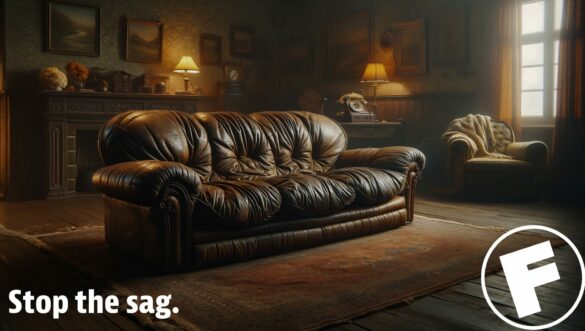
At some point or another, I’m sure you’ve seen a leather sofa with a big, sagging indention in the owner’s favorite spot.  Want to be sure your furniture never looks like that?  Here’s some info on why it happens and what to do to prevent it.  We’ve also included what to do if your leather chair is already sagging.

Why the sagging?

Sagging leather couch

Sagging leather couch

The main cause of sagging is that the leather isn’t getting the support it needs from furniture’s foam.  Leather stretches naturally, so it needs a firm foam base to support the people’s weight without sagging.

Stretching can also be affected in by the thickness of the leather hide used and by whether or not the tannery stretched it well before they put it on the furniture.  (Think of it sort of like having to wash fabric before you sew it.)

Avoid sagging seats

Before you buy:

1. It’s a good idea to buy couches and love seats that have several same-sized, removable cushions so you can switch them around periodically.  That way, the cushions are worn more evenly, and your favorite spot won’t start to sag as quickly.

2. The denser the foam is in the leather furniture you buy, the longer it will last before it starts to sag.  So, if you prefer stiff-looking leather, you might want to go in that direction.  However, keep in mind that many people think furniture with squishy foam is more comfortable than furniture with firm foam.  You have to find a balance and consider your own priorities.

3. Is more expensive furniture better? Unfortunately, the answer to that question has to be frustratingly vague.  More expensive leather is pretty much guaranteed to have nicer, better made leather.  But, more expensive leather does not necessarily have nicer foam.  Some high-end furniture retailers ensure that every part of their furniture is top quality, and other cut costs on foam.  Keep in mind that some high-quality leather furniture is intentionally made to be very soft, squishy and comfortable.  So, even though you pay the high dollar for a nice piece of furniture, choosing the comfy, squishy foam may mean that you have some sagging down the road.

Once you’ve got it:

The best thing you can do to avoid sagging seats is to distribute the use.  If you have furniture with cushions you can move, switch them out every couple of months.  If you don’t, try not to sit in the same place all the time.

What to do:

If your leather furniture is already sagging, your best bet is to get new filling put in it.  The cost will vary depending on the size of the furniture and the extent of the problem.

If you have any questions, leave ‘em in the comments!  If you want to show us a photo of a specific piece of furniture, post it on our Facebook wall or get in touch with a franchisee.

DeliciousDiggStumbleUponShare

Used Leather Furniture Buying Guide

Posted: Feb 17, 2011By: FibrenewCategory: General, Home and Office, Leather Advice From the Pros

Because buying used furniture is both eco-friendly and thrifty, it’s a very IN thing to do right now.  Here are some tips to be sure you make good buying decisions when it comes to used leather!

Check to see if the previous owner took good care of it:

  • We recommend that people use leather cleaner and protection cream to care for furniture several times a year.  Following those guidelines will make leather last a lot longer.
  • Look and see if there is dirt underneath the cushions.  If there is, it is likely that the owner did not clean and protect it often.

Compare pieces of a set to determine quality:

This might sound like common sense, but if you are looking at a set of furniture, line up all the pieces next to each other to compare each piece’s quality before you buy.

  • It is likely that some pieces were used more and are more worn than others.
  • Also, one piece of a used set may be more faded from the sun than others.
  • These are little differences that you might not notice in the store, but may drive you crazy once you get them in your home.  Setting them all up for comparison is a good way to avoid the issue.
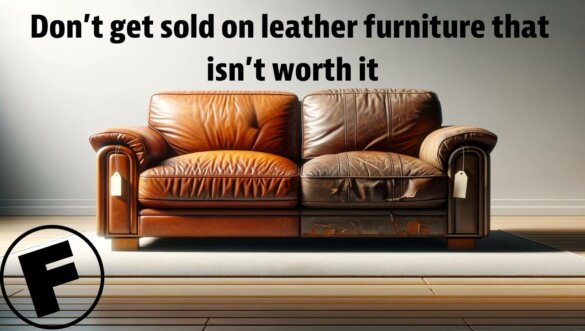
  • Also, keep in mind that if some pieces of a set look dramatically worse than others, it might be an indicator that the furniture doesn’t hold up well.
  • The new-looking pieces were probably not used very frequently, so they might still look pretty new.
  • It’s likely that the one or two pieces that look bad were the only ones that got used by the previous owners, and they just didn’t hold up well.  That could be a bad omen for the rest of the set.
  • Consider the age of the furniture.  If it is relatively new furniture that is already showing some wear, it could be a sign that it won’t hold up well in the future.  However, if the furniture is an older piece and is still only showing a little wear, that is likely a good sign of things to come.

Is it worth it to fix-up damaged furniture?

Sometimes.  We love the eco-friendly factor in buying and fixing up used leather furniture instead of buying new.  There are a lot of types of damage that are pretty cheap and easy to fix, making refurbishing a much cheaper alternative to buying new.  But, there are a few types of damage you should look out for and avoid because they are expensive to fix.

Cheap Fixes

  • Dinginess – If the piece is just a little dirty and dingy looking, it doesn’t cost much to pay a professional to thoroughly clean it.
  • A few minor scratches and scuffs – many professionals charge based on the number scuffs or scratches, so a few is going to make for a cheap repair.
  • Small Pen mark

Mid-range Fixes

  • Dog chew hole
  • Color missing on cushion surfaces and arms

High-end fixes

  • Body oil stains and spots
  • Visible stains
  • Damage near seams is always trickier and more expensive than damage that does not affect a seam

Let’s talk holes

Holes in leather are hard to drop into the “Cheap, Mid-range, High-end” fix categories because the size of a hole makes a big difference in how expensive it is to repair.  As a general rule, a hole with a diameter up to a one eighth of an inch is considered small, 1/8 to 1/2in. is mid-range and bigger that 1/2 in. is considered large.

Repairs in the long-run:

Some repairs are more likely to become a problem again later on down the road than others, so it’s a good idea to take that into consideration if you plan to hold onto this furniture for a while.  For example, other than a small scratch, a repair to the sitting area of a piece of furniture isn’t going to last as long as a repair in a place that never gets touched because of the constant movement.

Ah, the subjectivity!

Still wondering how dingy is too dingy?  Need a better idea of what, exactly, “cheap,” means?  We understand.  Anyone can send a photo to a local professional for a free quote before you buy.  Also, feel free to leave questions in the comments or post pictures on our Facebook!

DeliciousDiggStumbleUponShare

Subscribe:

twitter facebook

Categories

Latest Tweets


here