leather furniture Tag
Posted: Oct 17, 2011By: FibrenewCategory: Common Leather Problems, DIY, Leather Advice From the Pros
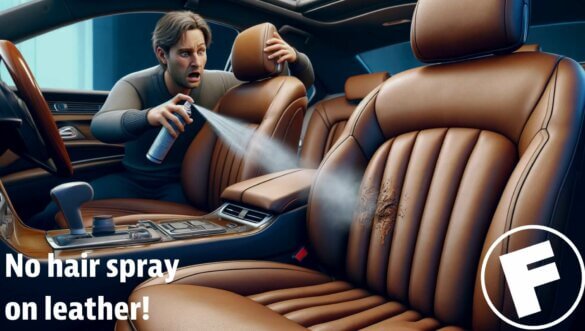
Hair spray has always been a favorite fix-all by old wives’ tale believers. Hair spray has been hailed as a solution for stain removal, stopping runs in tights and is now being used to remove stains from leather furniture.
While many of the ladies here at Fibrenew do insist that it works wonders on stocking runs, we are all 100 percent in agreement that you should NEVER try using it on leather.
There are two main reasons not to use hair spray on leather furniture or other upholstery:
- A lot of hair spray contains alcohol, and alcohol damages the surface of all types of leather upholstery. While you may not see the damage right after you spray it on, you will notice that it breaks down the leather’s ability to protect itself from damage down the road. This is especially true for fully-finished leather.
- Hair spray is always going to leave your leather feeling a little sticky. You might think of this as a minor nuisance and just wait for it to wear off, but the truth is that “just a little sticky” is actually more problematic than you might think. The hair spray residue will attract little tiny pieces of dirt and dust that you might not be able to see with the naked eye. This will cause abrasion as people move around on your upholstery, breaking down the protective topcoat on fully-finished leather and digging into and damaging semi-aniline or aniline leather.
There are a number of other home remedies and wives’ tales about using home products on leather. We do not advise using:
Questions or experiences with hair spray on leather? Post them in the comments!
Posted: Oct 10, 2011By: FibrenewCategory: Common Leather Problems, DIY, Home and Office, Leather Advice From the Pros
The business of dying leather is a tricky one, and you really can’t replicate it with any marker. People come to us all the time asking us to fix problems they’ve created trying to fix a bleached out or discolored spot on their upholstery with a similarly colored marker. The fact of the matter is that dyed leather usually has many layers and tones, and thinking you can find one marker that’s going to give you an exact match is like thinking a bottle of cheap hair dye is going to give your hair a natural look.

An example of a spot filled in with a brown marker
Now, if you just have a teeny tiny spot somewhere pretty hidden on your couch, car seat, etc. you might find marker results to be sufficient. But, if you want a discolored spot to match the rest of the piece, you really shouldn’t go the marker route. A professional, like Fibrenew, can usually re-dye spots for a very reasonable price.
There are a number of other home remedies and wives’ tales about using home products on leather. We do not advise using any of the following:
Questions or experiences with markers on leather? Post them in the comments!
Posted: Oct 3, 2011By: FibrenewCategory: Common Leather Problems, DIY, General, Home and Office, Leather Advice From the Pros
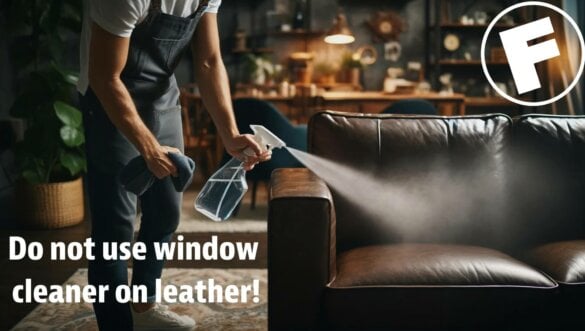
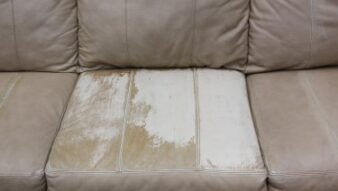
Most people, myself included, think of window cleaner as being one of the mildest of all cleaners. People consider it to be so mild they could use it on almost anything. Unfortunately, you really cannot use window cleaner on leather upholstery because almost all of it contains alcohol.
Alcohol will damage the surface of your leather, especially breaking down the protective top coat on fully-finished leathers that make up the vast majority of the leather upholstery market. Breakdown of this surface will leave your upholstery more susceptible to all types of damage in the future, like scratching and water damage.
Alcohol can also, in some cases, cause discoloration in leather.

This footrest has been slightly discolored with an orange hue because of an alcohol cleaner.

This couch has a slightly discolored mark because the owner used a cleaner with alcohol in it.
There are a number of other home remedies and wives’ tales about using home products on leather. We do not advise using any of the following:
Questions or experiences with window cleaner or other cleaners containing alcohol? Post them in the comments!
Posted: Sep 26, 2011By: FibrenewCategory: Common Leather Problems, DIY, Home and Office, Leather Advice From the Pros
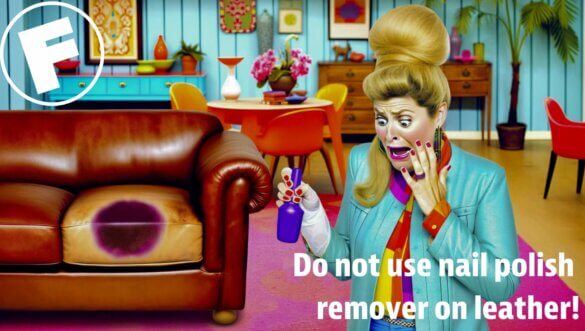
It’s true that finger nail polish will remove marks on leather upholstery, but it also removes the dyes that are supposed to be on the leather, leaving a bleached out spot on your leather’s surface. Finger nail polish also wears down the top coat on fully-finished leathers, leaving them more susceptible to damage.

Fingernail polish remover took the color out of this couch when the owner tried to use it to remove the pen mark.
There are a number of other home remedies and wives’ tales about using home products on leather including. We discourage the use of:
Questions or experiences with nail polish remover? Post them in the comments!
Posted: Sep 5, 2011By: FibrenewCategory: Common Leather Problems, DIY, Leather Advice From the Pros
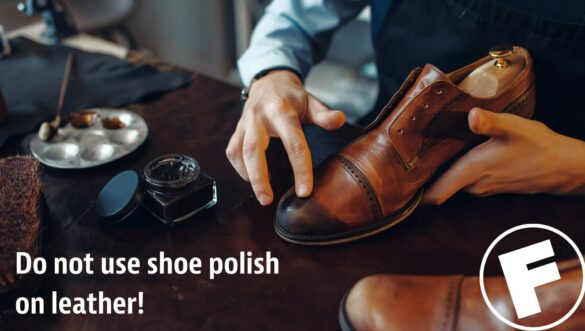
It is a common mistake to use shoe polish on leather upholstery. People try to use it on furniture and on their leather car seats, but it doesn’t work.
The leather used in upholstery is tanned differently from the leather in shoes. It does not soak up shoe polish like shoes do, so the polish will just sit on the surface of your leather and make a sticky mess.

Depending on the type of damage, you may have a number of other alternatives. Professional leather repair experts can usually fix scuffed, faded, torn or otherwise damaged leather for a fraction of the cost of replacing or reupholstering furniture and auto seats.
There are a number of other home remedies and wives’ tales about using home products on leather. We do not advise using the following:
- Olive oil
- Beeswax
- Hair spray
- Markers
- Window cleaner
- Finger nail polish remover
- Disposable cleaning supplies and wipes
Questions or experiences with shoe polish? Post them in the comments!
Posted: Aug 22, 2011By: FibrenewCategory: Common Leather Problems, DIY, Home and Office, Leather Advice From the Pros
When it comes to repairing and caring for leather furniture, there are hundreds of options. Furniture stores and online retailers offer up products that do everything from cleaning to dying leather. However, you should proceed with extreme caution when you use these DIY products on your furniture. I’ve heard and seen the effects of horror stories where these products ruined people’s leather furniture, so here are a few pointers on what to look out for.

1. Don’t use any products that contain alcohol or acetone. Alcohol seeps into and damages the protective surface of furniture leather. Acetone will remove the dye and color from leather.
2. Be sure to use products designed for upholstery. Leather used for shoes, jackets and clothing is very different than that used in furniture.
3. Only use products designed for the type of leather you have. Most furniture is made of aniline, semi-aniline or fully-finished leather. Because of the differences in finish, it is very important to use only products designed for the leather you have.
4. Dying leather is a highly specialized art. Professionals receive extensive training on color matching and dying, and it’s not at all likely that any DIY dye kit will produce very good dying results. So, be very careful with these products – test them on a part of the furniture that no one will ever see before you use it on the visible part of the piece.
5. Stay away from products that say they are for multiple surfaces, even if one of those surfaces is leather. Most of the time these products contain elements that will damage leather. It is best to stick with products made specifically for leather.
Also, there are lots of people out there who have heard old wives’ tales about household products to use on leather. Some of these can be helpful, but there are many that do not work and will ruin your leather furniture. One example is using olive oil to fix minor dings and scratches on leather. People also try using finger nail polish remover, shoe polish and window cleaner, among other things, to work on damaged leather. All of these options can cause major damage to your leather down the road.
Any questions? Have any experiences with leather products to share? Post them in the comments!
Posted: Aug 15, 2011By: FibrenewCategory: Home and Office, Leather Advice From the Pros
Leather furniture and upholstery will inevitably face some wear and tear throughout its life, and there are many types of damage you can’t avoid. However, sun damage is one problem that can definitely be prevented. Too much sunlight and heat will fade and/or dry out your leather.

Couch faded by the sun
Faded Leather
Fading is commonly seen in semi-aniline and aniline leathers, and it is less common in fully-finished leathers that have a protective topcoat. It’s a problem people frequently face, and, if you put your leather furniture next to a window that gets a lot of sunlight, you can see fading in as little as 4 to 6 months.
Dried Leather
Drying will occur with any type of leather. The sun’s heat slowly causes the moisture and natural oil in leather to evaporate. Over time, if you don’t care for your leather properly, it will dry out and crack.

Badly cracked chair
How to Prevent Sun Damage
One crucial step to preventing fading and cracking is to, if possible, keep your leather furniture out of direct sunlight. You can do all the right things to protect your sofa, but, if it’s directly in front of a sunny window, it is only a matter of time before the heat takes its toll. If you do need to place furniture in front of a window (we know, most people do), invest in some blinds to shade your furniture from the sun during the hottest, sunniest parts of the day. Those blinds will be a lot cheaper than taking your leather upholstery to a professional for patching and re-dying later on down the road.
Another important precaution to take is to clean and protect your furniture 3-4 times a year with a leather conditioning kit. For tips, check out our post on how to clean and protect your leather.
On a final note, do not try to treat your leather with olive oil or any other type of oil—it will end up causing major damage in the long run.
Questions? Comments? We’d love to hear from you!
Posted: Mar 7, 2011By: FibrenewCategory: General
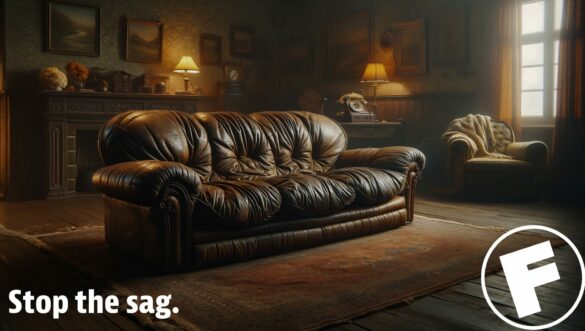
At some point or another, I’m sure you’ve seen a leather sofa with a big, sagging indention in the owner’s favorite spot. Want to be sure your furniture never looks like that? Here’s some info on why it happens and what to do to prevent it. We’ve also included what to do if your leather chair is already sagging.
Why the sagging?

Sagging leather couch
The main cause of sagging is that the leather isn’t getting the support it needs from furniture’s foam. Leather stretches naturally, so it needs a firm foam base to support the people’s weight without sagging.
Stretching can also be affected in by the thickness of the leather hide used and by whether or not the tannery stretched it well before they put it on the furniture. (Think of it sort of like having to wash fabric before you sew it.)
Avoid sagging seats
Before you buy:
1. It’s a good idea to buy couches and love seats that have several same-sized, removable cushions so you can switch them around periodically. That way, the cushions are worn more evenly, and your favorite spot won’t start to sag as quickly.
2. The denser the foam is in the leather furniture you buy, the longer it will last before it starts to sag. So, if you prefer stiff-looking leather, you might want to go in that direction. However, keep in mind that many people think furniture with squishy foam is more comfortable than furniture with firm foam. You have to find a balance and consider your own priorities.
3. Is more expensive furniture better? Unfortunately, the answer to that question has to be frustratingly vague. More expensive leather is pretty much guaranteed to have nicer, better made leather. But, more expensive leather does not necessarily have nicer foam. Some high-end furniture retailers ensure that every part of their furniture is top quality, and other cut costs on foam. Keep in mind that some high-quality leather furniture is intentionally made to be very soft, squishy and comfortable. So, even though you pay the high dollar for a nice piece of furniture, choosing the comfy, squishy foam may mean that you have some sagging down the road.
Once you’ve got it:
The best thing you can do to avoid sagging seats is to distribute the use. If you have furniture with cushions you can move, switch them out every couple of months. If you don’t, try not to sit in the same place all the time.
What to do:
If your leather furniture is already sagging, your best bet is to get new filling put in it. The cost will vary depending on the size of the furniture and the extent of the problem.
If you have any questions, leave ‘em in the comments! If you want to show us a photo of a specific piece of furniture, post it on our Facebook wall or get in touch with a franchisee.
Posted: Feb 17, 2011By: FibrenewCategory: General, Home and Office, Leather Advice From the Pros
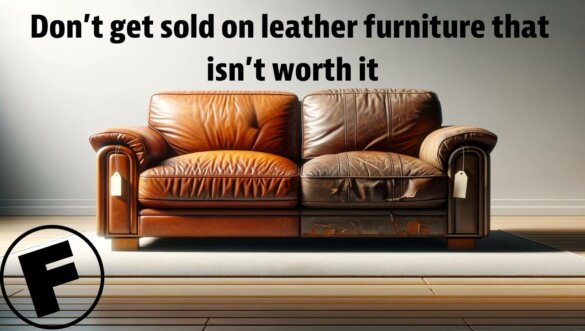
Because buying used furniture is both eco-friendly and thrifty, it’s a very IN thing to do right now. Here are some tips to be sure you make good buying decisions when it comes to used leather!
Check to see if the previous owner took good care of it:
We recommend that people use leather cleaner and protection cream to care for furniture several times a year. Following those guidelines will make leather last a lot longer.
- Look and see if there is dirt underneath the cushions. If there is, it is likely that the owner did not clean and protect it often.
Compare pieces of a set to determine quality:
This might sound like common sense, but if you are looking at a set of furniture, line up all the pieces next to each other to compare each piece’s quality before you buy.
- It is likely that some pieces were used more and are more worn than others.
- Also, one piece of a used set may be more faded from the sun than others.
- These are little differences that you might not notice in the store, but may drive you crazy once you get them in your home. Setting them all up for comparison is a good way to avoid the issue.
- Also, keep in mind that if some pieces of a set look dramatically worse than others, it might be an indicator that the furniture doesn’t hold up well.
- The new-looking pieces were probably not used very frequently, so they might still look pretty new.
- It’s likely that the one or two pieces that look bad were the only ones that got used by the previous owners, and they just didn’t hold up well. That could be a bad omen for the rest of the set.
- Consider the age of the furniture. If it is relatively new furniture that is already showing some wear, it could be a sign that it won’t hold up well in the future. However, if the furniture is an older piece and is still only showing a little wear, that is likely a good sign of things to come.
Is it worth it to fix-up damaged furniture?
Sometimes. We love the eco-friendly factor in buying and fixing up used leather furniture instead of buying new. There are a lot of types of damage that are pretty cheap and easy to fix, making refurbishing a much cheaper alternative to buying new. But, there are a few types of damage you should look out for and avoid because they are expensive to fix.
Cheap Fixes
- Dinginess – If the piece is just a little dirty and dingy looking, it doesn’t cost much to pay a professional to thoroughly clean it.
- A few minor scratches and scuffs – many professionals charge based on the number scuffs or scratches, so a few is going to make for a cheap repair.
- Small Pen mark
Mid-range Fixes
- Dog chew hole
- Color missing on cushion surfaces and arms
High-end fixes
- Body oil stains and spots
- Visible stains
- Damage near seams is always trickier and more expensive than damage that does not affect a seam
Let’s talk holes
Holes in leather are hard to drop into the “Cheap, Mid-range, High-end” fix categories because the size of a hole makes a big difference in how expensive it is to repair. As a general rule, a hole with a diameter up to a one eighth of an inch is considered small, 1/8 to 1/2in. is mid-range and bigger that 1/2 in. is considered large.
Repairs in the long-run:
Some repairs are more likely to become a problem again later on down the road than others, so it’s a good idea to take that into consideration if you plan to hold onto this furniture for a while. For example, other than a small scratch, a repair to the sitting area of a piece of furniture isn’t going to last as long as a repair in a place that never gets touched because of the constant movement.
Ah, the subjectivity!
Still wondering how dingy is too dingy? Need a better idea of what, exactly, “cheap,” means? We understand. Anyone can send a photo to a local professional for a free quote before you buy. Also, feel free to leave questions in the comments or post pictures on our Facebook!